2 Peter 1:5-6, 8: "And beside this, giving all diligence, add to your faith virtue; and to virtue knowledge; And to knowledge temperance; and to temperance patience; and to patience godliness; ...For if these things be in you, and abound, they make you that ye shall neither be barren nor unfruitful in the knowledge of our Lord Jesus Christ."
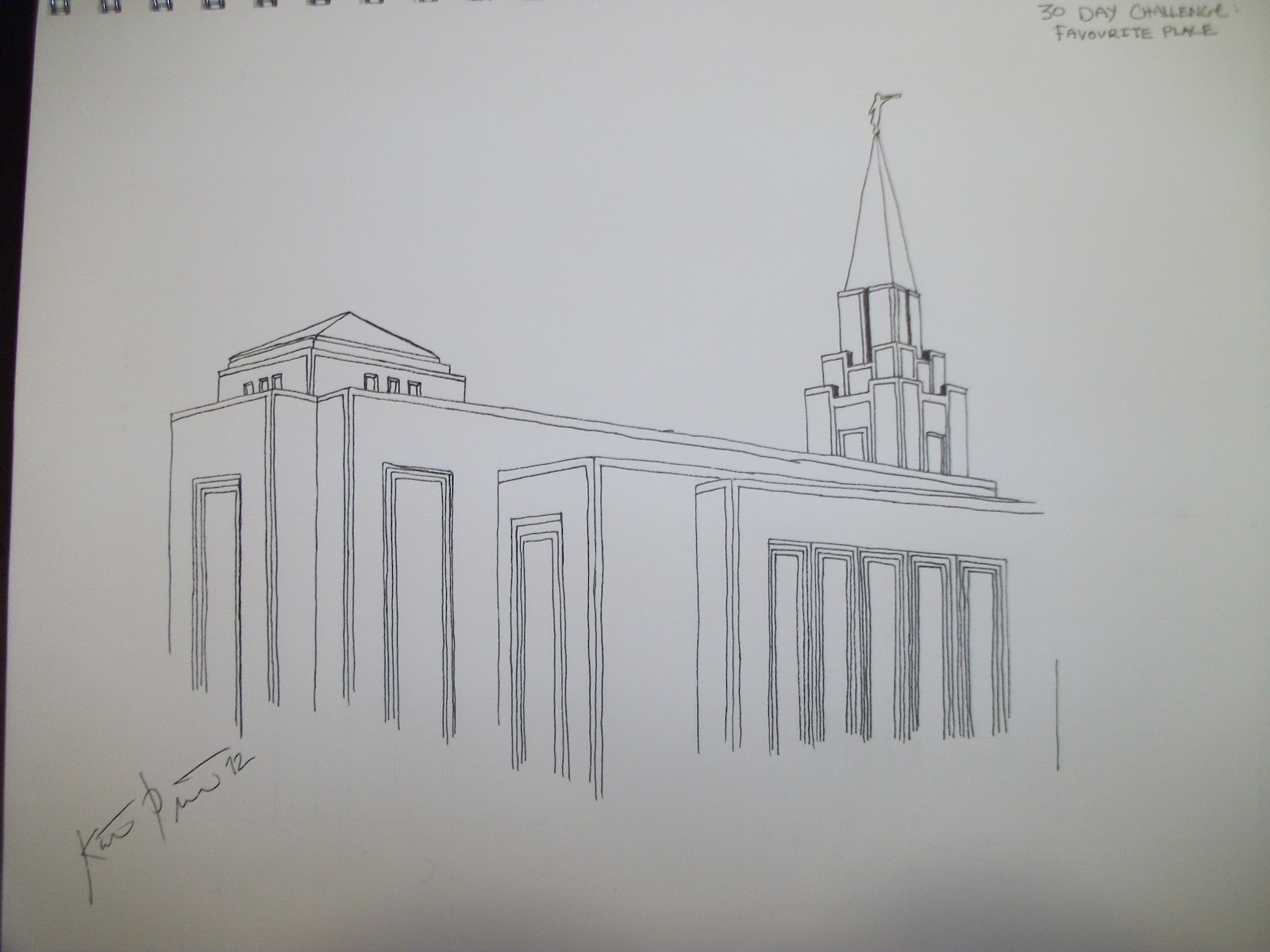
I know, I know... I'm lagging behind - I just had to figure out what my Favourite Place was for Day 4 o' this swell challenge. At first I thought, "since I'm such a narcissist, I should draw the upper half of my head, and then a bunch of junk, so it looks like the viewer is looking into my mind...", but decided against it after thinking it through while driving.
So, I grabbed some source material, and got to work; I present to you, dear reader, Day 4 o' this swell Drawing Challenge, my favourite place: the Langley, British Columbia temple of The Church of Jesus Christ of Latter-day Saints!
All right, feeling gross and ill has kept me away, so I apologize for that, but let's get back into it. This is a... Review, I suppose, for the film, "Jesus Christ/Joseph Smith," produced by "Search for the Truth." From what I can tell, this is meant to be an unbiased analysis of Mormonism and how it compares to Christianity. This I find funny. Are Christians not defined as people who believe in, and follow the teachings of Jesus Christ? Apparently not. Let's dive in, shall we?
In my post entitled, ""Joseph Smith/Jesus Christ": Poignant or Pointless?", I listed two flaws in the film. One was the use of a quote by Elder Orson Pratt, taken from the periodical known as The Seer, which in 1865, received this damning statement from the First Presidency and Quorum of the Twelve. With regard to Elder Pratt's teachings they said, "The Seer [and other writings by Pratt] contain doctrines which we cannot sanction, and which we have felt impressed to disown, so that the Saints who now live, and who may live hereafter, may not be misled by our silence, or be left to misinterpret it. Where these objectionable works, or parts of works, are bound in volumes, or otherwise, they should be cut out and destroyed." Now, the quote is a pretty good one, where Elder Pratt wrote, "Convince us of our errors of doctrine, if we have any, by reason, by logical arguments, or by the Word of God, and we will be ever grateful for the information." Some context for this quote would have been nice, especially since someone searching for that quote would run across the fact that in that article, Elder Pratt was addressing his defenses of polygamy. Without knowing of the existence of the statement made by the leaders of the Church, that could perhaps cause some degree of damage someone's faith. Although, that's the job of the people at "Search for the Truth."
I haven't looked into any more of the video yet than I had watched as of Sunday, April 18th, so I can only presume that the way in which they quote scripture will continue throughout the rest of the video. What I'm referring to is the fact that they'll summarize the part of the scripture they aren't interested in, and then quote whatever part of the scripture they consider the focus. This is not only misleading but has a tendency to pervert the scriptures, and places on that scripture the restrictions of whatever interpretation they have made in their summary.
Let's continue. I'd say, "onward and upward," but something tells me that's not somewhere this DVD is heading, specifically in terms of how it's probably going to present the Church of Jesus Christ of Latter-day Saints. So this is obviously where I think this DVD is headed, and after my analysis is done, I'll write a much shorter review of their DVD, just to sum things up.
OK, instantly, by their dividing of Joseph Smith and Jesus Christ to "determine which one holds the truth," we're presented with a dichotomy, as though Joseph Smith and Jesus Christ cannot be accepted together. I feel somewhat deceived, because the form of Christianity we're being presented with is the version of it that is riddled with Catholic believes, such as the Trinity. We're asked, "did he become a god through the faithful keeping of his ordinances, or has he always been the only true God?" This we're told, despite references in the Bible to Jesus Christ and his Father, such as the statement made by Christ at Golgotha, recorded in Matthew and Mark (with slight differences), "...Jesus cried with a loud voice, saying, Eli, Eli, lama sabachthani? that is to say, My God, my God, why hast thou forsaken me?" Why would Christ ask this? If he is God and Christ, could he really forsake himself? How do they explain this scripture? Food for thought, and no doubt something to keep in mind while we venture through this DVD.
Another dichotomy is the presentation of scriptures: the Bible, or the Book of Mormon. The Book of Mormon is claimed by the Latter-day Saints to be the most correct book on earth. Indeed, the Prophet Joseph Smith said, "I told the brethren that the Book of Mormon was the most correct of any book on earth, and the keystone of our religion, and a man would get nearer to God by abiding by its precepts, than by any other book." (Joseph Smith, History of The Church of Jesus Christ of Latter-day Saints, 7 volumes, edited by Brigham H. Roberts, (Salt Lake City: Deseret Book, 1957), 4:461) This does not mean that the Book of Mormon is without errors, nor does it mean that we disbelieve the Bible. Our 8th Article of Faith states, "We believe the Bible to be the word of God as far as it is translated correctly; we also believe the Book of Mormon to be the word of God" (italics added). We believe in, and revere the Bible, but believe it was a book for the people of old. The Book of Mormon is likewise believed in and revered, the difference being that we believe it has come forth by the gift and power of God for the generations of people on the earth right now.
OK, now around 2:30 minutes into it, we're presented with the claims, or dichotomies, of Mormonism and Christianity: "both claim Jesus is the Christ, both refer to the teachings of the Old Testament, both claim to be the truth." Am I the only one seeing a problem here? Then, "lets now examine these two men and their teachings." A 10 second backtrack will reveal something interesting. She says, "both claim Jesus is the Christ." A look through Merriam Webster's dictionary tells us that a Christian is " one who professes belief in the teachings of Jesus Christ." So what's with this splitting of "Christianity," and "Mormonism," when Mormons are, in fact, and by definition, Christians?
Can you tell I'm having fun? Now, at just under 3 minutes into this, we're examining the person of Jesus according to "Search for the Truth." This is where I'm going to stop this post. And in explaining why, it's due to the fact that, although it may sound silly, or funny or ridiculous, I'm feeling too contentious. At this point I'd rather have a post that's as unbiased as it can possibly be, and when people become emotionally involved in their subject, bias is more prone.
Since the introduction has been covered though, I think it'll be relatively easy to go through the rest, especially since the groundwork has been set about which kind of Christianity is being compared here, and we've established that it's somewhat backwards in it's analysis of there being a dichotomy of either Christianity or Mormonism.
While puttering around my documents I located one entitled, "Anti-Mormon Drivel." I've mentioned it before, but one of my siblings had made a post on their LiveJournal, which has since been taken down, about various fallacies regarding the Church. I think he was simply upset and trying to "educate" those in our family who had joined the Church, or was just venting, but the post wasn't kind at all. After reading it, many years ago, I resolved to look up each reference in the paper and refute it with the truth. Believing it to be lost, I worked hard to try and find the batch of lies again so I could address them, but to no avail. Having found it gives me great satisfaction. It's about three pages or so and I've refuted a couple points it brings up, but will be working hard at finishing my rebuttal. It was with great disappointment that in looking for it in a search engine, I was drawn to the supposed "original." I was just upset that my sibling hadn't actually looked up anything about the Church, but instead copied and pasted what someone else had put out there. So! The point of this post is to express my happiness in having found it, and to assure everyone that it'll be a good read once I have it posted - so check back!
So, I had the opportunity to go to the temple on Saturday with some out-of-country friends: a former Sister missionary and her husband, their daughter and mother-in-law. As soon as we got over the crest of the hill, I saw a lone protester and was instantly giddy. I don't know what it is, but ever since I went to Salt Lake for the October 2008 General Conference, I find protesters to be.. well, a form of entertainment I guess.
Here's a photo I took from atop the Conference Centre of the protesters along the Square. My favourite is the guy left of centre, yeah, the one in the Satan outfit.
When I first joined the Church I had never heard of the "Mormons," and a few months into the year 2004 I went online and began looking at anti-Mormon material. I got wound up in this particular LiveJournal that claimed to be a place for "recovering Mormons," meaning LDS members who had left the faith. I forget the subject matter, but something caught my attention and I experienced a trial of faith. I posted a few times on the LJ and although a few of the people there claimed I was a "troll," someone else seemed keen on helping me through my difficulty, no matter which direction I chose: to continue with the Church, or to leave it. They believed I was actually experiencing a trial of faith, and I'll always be grateful to that mystery person for not pushing their own agenda but for helping me figure out what I wanted and believed.
Anyway, since then I've always been drawn to anti-Mormons, and though I stayed away from it for a couple years after that, I've gone through two stages with regard to my reactions to them: first I felt anger towards them, and now I react with a bit of humour. Yes, I find anti-Mormons funny. Well, for the most part, that is until I actually meet one who knows what they're talking about and have done their own research - then my response is a kind of searching interest.
So when we were leaving the temple, we pulled out into the street and saw a man handing out newspapers and little DVDs. I was intrigued because there was a picture of the Saviour and a picture of Joseph Smith on the cover. It's called "Jesus Christ/Joseph Smith," and is produced (as far as I can tell) by an organization called "Search for the Truth." In other words, this wolf in sheep's clothing was handing out DVD's to let people visiting the temple know the differences between Mormonism and Christianity. I'll edit that I think: the differences between Mormonism and Mainstream Christianity. As far as I'm concerned, there is a difference between the Christianity of today and the Christianity from Biblical times. A big difference.
So this is just an introduction to that video, which I'll watch within the week, and then post on. It's not looking good though; I'm only three and a half minutes in and I've found two errors. The first is within a quote by Orson Pratt, which is shown onscreen and states, "Convince us of our errors of doctrine, if we have any, by reason, by logical arguments, or by the Word of God, and we will be ever gratefull for the information." As I'm an English major, I can't ignore the spelling mistake in the word "grateful." As for this quote, it's from a periodical Elder Pratt published in called The Seer (careful, that's a large PDF file), and that particular quote comes from an article he wrote defending polygamy. In 1865, the First Presidency and Quorum of the Twelve released this statement with regard to Elder Pratt's teachings, "The Seer [and other writings by Pratt] contain doctrines which we cannot sanction, and which we have felt impressed to disown, so that the Saints who now live, and who may live hereafter, may not be misled by our silence, or be left to misinterpret it. Where these objectionable works, or parts of works, are bound in volumes, or otherwise, they should be cut out and destroyed."
The next error seems to just be a part of what mainstream Christianity likes to do, that is, "simplify" the scriptures. On screen we're shown a supposed quote from the Book of Abraham, found within the LDS' Pearl of Great Price. Now, if you just read what it says, it seems like they're actually quoting the scripture, but instead they quote part of it and "simplify" the rest. Here's what they show: "Our Father said, 'Whom shall I send?' Two of our brothers offered to help. Our oldest brother, Jesus Christ, who was then called Jehovah, said, 'Here am I, send me." The way I first read it made me think the way most people would, that they were quoting, word for word, from the scriptures. I picked up my scriptures and thumbed through it until I found Abraham 3:27, curious about what they "simplified." The scripture reads: "And the Lord said" Whom shall I send? And one answered like unto the Son of Man: Here am I, send me. And another answered and said: Here am I, send me. And the Lord said: I will send the first." Now, I understand that mainstream Christianity uses different terms for the Saviour and for God, but is it really so difficult to understand? My real upset comes from the way they format this, making it appear as a quote when it isn't. Format, people, format.
All right, so this has been, like I said, the introduction. Yes, three and a half minutes has been stretched into two large paragraphs. Using simple math, this hour and twenty minute long video will probably be turned into about 23 paragraphs. Not only am I working on this video now, but I've got a commentary/review on current Quorum of the Twelve President, Boyd K. Packer's "The Holy Temple," (synopsis found here) in the works, as well as the previously mentioned posts on excommunication, the documentary known as "The Mormons," prayer regarding the Book of Mormon, and one on the purpose of temples. In other words, make sure you check back weekly for new posts!
So this morning I've had a few moments to think about the depth to sin. I don't say that meaning "oh, yes, sin is sooo deep, so cool," in the sense that is often used these days when we compliment someone by telling them how deep and mysterious they are. I'll argue the complete opposite for sin, it isn't mysterious at all. By depth, I mean it in the sense that it can pull us in so tightly, to the point that our lips are barely gracing the surface of the water to give us breath.
Anyway, so as I was dreaming away I was awoken by a fist pounding on a door. I thought to myself, "Oh no, I've slept in," because I figured it was my mom banging on my little brother's door to wake him up for one of his classes. So I stared up at my ceiling wondering and listening: I knew I'd learn the truth of the situation given a little time. Yes, it was my mom pounding on the door, and yes, she was trying to wake him up.. But for a reason I didn't expect.
I confess myself gullible. I've been told by a few people I'm not really that close to that they've noticed I tend to "look for the good in people." I work hard at developing that because it's such a rarity in our times. I suppose it means something when someone shouts at another to wake up, bangs on their door and I don't automatically jump to the conclusion that one of them must have done something wrong. Well, that's what I did this morning. Which is why my thoughts on sin seem so revelatory.
As the situation progressed I learned that my mom had had some money in her jacket pocket and that in the course of the early morning, it had gone missing. My mom's main reason for believing my brother had taken the money was due to the fact that the kid keeps such strange hours! It seems to me that he's awake during all hours of the night and early morning, but I won't see him at all during the day until around supper-time. Anyway, the conversation they were having turned to undertones after she demanded he give her the money. It's all the same to me: it left me to my thoughts.
And the collection of those thoughts can be summed up relatively nicely in a single, short sentence: sin is poison. Afterward, before hearing my mom walk down the stairs, I heard her explain why that money had been in her pocket: she needed to pay for parking at the hospital. I don't know if I should given my previous admission, but I assume that if my brother had known that he wouldn't have touched the money, not because he'd eventually get caught, but because innately he is a good person.
No one is perfect, and I'm not posting this experience to show how flawed my sibling is. I could never make the claim that I've never stolen anything, money or possessions; that I've never lied about stealing something or to cover up some stupid thing I had chosen to do. That's a beautiful truth though: we choose.
So as I lay there I wondered something: when do you get to the point where although your initial sin was the width of a string, the sins you commit now are thicker than bound thread (think friendship bracelet width). Why don't we recognize we've fallen down a path that leads to greater sin?
To borrow a metaphor that I've often heard within (but also outside of) the Church, sin is like a frog in a pot. We're taught that Satan, mankind's adversary operates much in this way: when you put a frog in a pot of hot water, it jumps out. However, when you place that frog in a pot of cold water and turn up the heat, it will sit in that water until it boils to death. Gruesome, no? The adversary is similar in that he would never try to prompt me, an active Church member (saying prayers, reading scriptures daily, attending sacrament and other Sunday meetings, youth meetings weekly, etc.), to break the Law of Chastity. That's just a silly thing to suggest to someone in my position. A much better temptation, to get me down that road would be something like this: when I encounter an unclaimed bus ticket for the month, tell me I should pick it up and use it - it would save me money on fares, plus, I could still ask people for bus fare without actually needing it so I could save it for my mission. Strange, no? Well, remembering what my goals are and what covenants I've made, although it may be a little difficult to say "no," it's do-able. That was an actual experience I had earlier this month, and I puzzled about it for awhile: steal so I could put the funds towards a mission? Such is how the adversary works. He's a walking contradiction.
Back to the topic at hand. The depth of sin: how do you take a child who is innocent and honest, and within a handful of years turn them into a thieving liar. Harsh words that I don't direct at anyone, but how is it done? The frog in the pot idea.
During the 179th General Conference, a talk was given by President Dieter F. Uchtdorf (I don't understand why it's so hard for some people to say his surname!) in which he said this: "...what we love determines what we seek. What we seek determines what we think and do. What we think and do determines who we are—and who we will become."
During a poster sale held in the concourse of my college, I was tempted to buy a poster that reminded me of President Uchtdorf's words: "Watch your thoughts, for they become words. Watch your words, for they become actions. Watch your actions, for they become habits. Watch your habits, for they become character. Watch your character, for it becomes your destiny."
So it doesn't seem too far-fetched that I've come to this conclusion, but you can't take a little kid and turn them into anything. That kid can however, through poor choices, turn themselves into a thieving liar. Whether you're religious or not, I'm sure it's no stretch to accept the fact that there are things which should not be done.
If we use the logic that things which aren't good for people or the society we're in then they shouldn't be done. Simple logic. If it's bad for you, don't do it: For example, drugs have negative effects on people: they should not be used. If you believe marijuana has no adverse effects, but is illegal in your country, you shouldn't smoke it. Stealing has a negative effect on the person being stolen from, it shouldn't be done.
In addition, I'm grateful that we don't just have to rely on societal laws to determine what's good for us and what isn't.
So the next time someone says, "I stole that because I had to," or, "you made me do it," just gently remind them that you can't make them do anything (or I'm sure you'd have made them not do whatever thing was objectionable), and that they're in charge of who they are, what they become.
I can't just finish here. I can't just say, "if you're a failure it's your own fault." There is some kind of solution, isn't there?
Knowing someone who is in the 12-step program for Alcoholics Anonymous, I know that there are several steps that require the person in the program to make amends. Step 8 requires the person to make a list of all the people they've harmed and be willing to make amends. Step 9 requires that they then make amends.
So how do you fix the negative things you've done? If you believe in the Atonement of Christ then you ask him for forgiveness in full sincerity of heart, and be resolved to not repeat that mistake or transgression. If you don't believe in Christ, then just follow what those in the AA-program do. Make your list, apologize and acknowledge to those you've hurt what you've done to harm them, and then make restitution if possible (pay them back the money you stole, buy them a new stereo to replace the one you busted, whatever). The AA-program is designed in such a way that once someone commits to it, they aren't allowed to drink again. Ever. I think the final secular step in restitution is the same as the one that involves the Atonement: resolve yourself to not repeat those base choices again. If you get back into the cycle that brought you to where you were before you sought forgiveness, you really haven't "quit" that habit, and therefore through your misdeeds have lost the forgiveness you had had before.
I'm taking a short intermission from posting because school has started up again since the Olympics ended (although the Paralympics have begun). This post is a paper I wrote for my western religions class. I'm not going to bother adding hyperlinks in the paper part of it because the sources are all listed at the end.
So, just a note: I realize there's a lot of fractures in my discussion. I had a difficult time consolidating information and staying away from deep doctrines. When I talked to my older brother about the paper topic, he asked if I was going to write something in there about polygamy. While this was a doctrine in the early years of the Church, as I told him, the point of this paper wasn't to discuss the "absurdities of Mormonism," (Farkas & Reed, see sources) as some have put it, or the controversies. Again, while I've no doubt it would interesting, this is not a paper on controversies.
Also, ignore the formatting issues, I don't feel compelled to fix it up. Oh yeah, and it's absurdly long.
And aside from all that, enjoy, and let me know what you think.
In Christendom, there are an overwhelming number of individual churches, almost all of which branch from early Christianity. After the martyrdom of Jesus Christ, it becomes difficult to trace what happens, not necessarily to Christ’s disciples, but to the church that Jesus Christ organized while he yet lived. Most of present-day Christian churches have their origins from the Ecumenical councils called by the Roman emperor Constantine (most of which were organized after the Great Schism). There are however, a few denominations within Christianity which claim some form of restoration, like Protestantism, but there appears to only be one which claims to be a full restoration of Christ’s early church. The Church of Jesus Christ of Latter-day Saints (hereafter referred to as the LDS), commonly called Mormons, has its roots in New York where founder Joseph Smith asserts his visitation by God and Jesus Christ, and the eventual re-establishment, or restoration of Christ’s early church (Nelson 3, 17-18). The purpose of this paper is not to examine the validity of the LDS church, but to determine the major doctrines which set it apart from what are currently the accepted doctrines of Catholicism (as Catholicism and Mormonism are the second and third largest branches of Christianity, respectively)(Pew) and most non-denominational Christian faiths.
Seemingly vital to any Christian faith or religion is the belief that the Bible is the word of God, the men leading you have some kind of authority to do so (sic not just men with good ideas), and that God has revealed Himself through scriptures and His prophets and is somehow guiding the affairs of men. Catholics and the rest of Christendom accept the Bible to be the word of God, some believe in its inerrancy (Gerstner), and others take it literally. Catholicism holds that scriptures are documents received from God, and are the property of their church, although only appointed teachers may officially instruct from them (Maas). LDS have declared that they “believe the Bible to be the word of God as far as it is translated correctly” (Articles of Faith 1:8). Those of the LDS faith not only utilize their Bibles as scripture, but believe in a very open canon and a constant and continuing flow of revelation from God, both on a personal and on a church-wide level (Church of Jesus Christ 128-129); these doctrines carry back to the days when the church was organized in 1930 [edit: 1830]. LDS believe that God will answer their prayers, and directs their church through men (sic prophets) who have received Christ’s priesthood (Nelson 15-16), which is authority given to man to act in the name of God (Ballard 39). Not only this, but LDS claim additional scripture to the Bible, known as the Book of Mormon, the Doctrine and Covenants, and the Pearl of Great Price (Bushman, 44-45). These are three major distinctions between the LDS and the Catholics. Put into perspective, and with no disrespect, one might venture to say that the LDS one has the opportunity to be a progressive faith, whereas the Catholic one is a relatively static faith. Although the Bible states that “Jesus Christ [is] the same yesterday, and to day, and for ever” (Hebrews 13:8), mankind is constantly changing and needing, in layman’s terms, advice from God as they, and as the world continually changes.
Despite the changes facing mankind, what defines a Christian is based on the doctrines established by the early Ecumenical councils, something which has not seen much change. One such doctrine established involves the godhead, or the relationship between God, Jesus Christ and the Holy Ghost. Catholics and some traditional Christians hold that these three members of the godhead are three individuals, who are of one substance (Joyce). What this means, in an overly simplistic explanation, is that although they are distinct from each other, they are indeed one in the same and that God is the Holy Spirit, and is Christ. This doctrine also supports the accepted doctrine that Mary is not just the mother of Christ, but through extension of the Trinity, is also the mother of God. There are two examples in scripture used to establish the doctrine of the Trinity, the first is used to establish the divinity of Christ and their “oneness,” and the second is used to show that Christ is on the same level, and is indeed also God.
2 Corinthians 13:13 (2 Cor. 13:14 in the King James Bible follows)
The grace of our Lord Jesus Christ and the charity of God and the communication of the Holy Ghost be with you all. Amen
The grace of the Lord Jesus Christ, and the love of God, and the communion of the Holy Ghost, be with you all. Amen.
This scripture is used to illustrate the divinity of Christ, being mentioned in the same sentence with God and the Holy Ghost, as well as the idea of their being three distinct persons. Additionally, in Psalms, another scripture is used to illustrate that when David praised the Lord, he was doing so in such a way that was reserved for God alone.
Psalms 104:31
May the glory of the Lord endure for ever: the Lord shall rejoice in his works.
The glory of the Lord shall endure for ever: the Lord shall rejoice in his works.
It is widely accepted by Catholicism and most of Christendom that the godhead is three persons in one being, that the Trinitarian God does not have a body, that Christ has a physical body, and is the Son of God (and is the second member of the Trinity), and that the Holy Spirit is also God, as well as the third member of the Trinity.
The LDS on the other hand, view the godhead as having three individual and distinct members who play different roles (Talmage 8, 31-33). In this version of the godhead, God is the Heavenly Father of all the spirits of mankind, who has a physical body. Jesus Christ is the Savior of the world but is not only the Son of God; he is God’s first spiritual and literal child. The Holy Spirit is the third member of this godhead, much like within the Trinitarian godhead, but is separate from God and Christ, is a “personage of spirit” (D&C 133:22) and also ministers to men in place of Christ.
Doctrine and Covenants 93:21
And now, verily I say unto you, I was in the beginning with the Father, and am
the Firstborn;
This scripture illustrates the LDS doctrine that not only is Christ the Son of God, but also that mankind existed in a spiritual state prior to being born on Earth known as the pre-existence (which will be discussed later). The following scriptures are explanations of the Holy Spirit, the first from Christ, explaining that his disciples will be given guidance after he left (sic was crucified), and the second demonstrates that although the Holy Ghost as an individual can only be in one place at a time, his influence can be everywhere at the same time:
John 14:26
But the Comforter, which is the Holy Ghost, whom the Father will send in my
name, he shall teach you all things, and bring all things to your remembrance,
whatsoever I have said unto you.
Moses 5:14
And the Lord God called upon men by the Holy Ghost everywhere and
commanded them that they should repent;
With regard to Mary, LDS believe she was an honourable and chosen woman, and that she was the mother of Christ (Talmage 77-79). They do not accept the doctrine of Immaculate Conception or that Mary remained a virgin after the birth of Christ. The latter doctrine is evidenced by the following scripture:
Matthew 1:25
And knew her not till she had brought forth her firstborn son: and he called his name JESUS.
As is understood, and as a brief look at a dictionary will show, the archaic and Biblical understanding and definition of the term “to know,” is to have sexual intercourse. Therefore, this scripture teaches that Joseph did not just stay in a celibate relationship with his wife, but consummated their marriage sometime after the birth of Christ.
It is difficult to fully grasp the concept of the Trinity because God is typically viewed as unknowable and incomprehensible (Joyce). Scriptures have been searched a great deal in order to support the notion of the Trinity because the alternative is not possible; the Trinity needs scriptural basis because Catholicism denies the doctrine of continued revelation, or the idea that God still speaks to man, as well as that of an open canon. While both Catholicism and the LDS share the similar dogma that Christ is the Son of God, there are severe differences in the relationships between the three persons, the roles they play, and the relationship between God, Christ and Mary.
As mentioned earlier, there are several beliefs held by LDS about a pre-existence which is not shared by Catholics, let alone by the rest of Christendom. It may very well be safe to say that unless one has had exposure to this particular LDS belief, one may never have heard of it before. Although in the Catholic faith the only eternal entities are God and Christ (Joyce), the LDS belief is that all members of the human race are children of God, and that before being born on Earth, they lived with God in a state known as the pre-existence (sic pre-Earth life) (Talmage 7, Ballard 70-73). In this state, mankind was presented with a plan in which they would go to Earth with no memories of their pre-life to be tested. This test involved sin, which would separate mankind from ever returning to God post-Earth life, so a Mediator was needed. Christ then, during this council offered to be such a Savior, while Lucifer (who is explained as being Christ’s brother because all of mankind are spirit-children of God) desired only the power of God, and in return would force all mankind to choose to be righteous (Talmage 7-10). God cast Lucifer from heaven and he became Satan, who has only the goal to make mankind miserable (Book of Mormon, 2 Nephi 2:27).
This doctrine leads directly into the next, which is in regard to the Fall of Adam and Eve from the Garden of Eden. In Catholicism, the Fall is a mar on humanity, an event for all mankind to be utterly ashamed of. In this view, Eve yields to temptation, breaks God’s commandment to not eat the fruit from the tree of the knowledge of good and evil, and then seduces Adam into eating the fruit as well (Driscoll). In this, the doctrine of Original Sin has its roots. According to Catholicism, because Adam and Eve disobeyed God, every human being ever born has inherited that sin and has been damned to never be able to return to heaven because of it (although this is where Christ and sacraments step in) (Driscoll).
The LDS view of the Fall is quite different and is viewed as a blessing instead of a shame. The view held by LDS is considerably clearer because of their open canon:
Genesis 2: 16-17
And the Lord God commanded the man, saying, Of every tree of the garden thou
mayest freely eat: But of the tree of the knowledge of good and evil, thou shalt not eat of it: for in the day that thou eatest thereof thou shalt surely die.
Pearl of Great Price, Moses 2:28
Be fruitful, and multiply, and replenish the earth, and subdue it, and have dominion
over... every living thing that moveth upon the earth.
Using these scriptures, LDS illustrate that God gave two commandments to Adam and Eve, to replenish the earth and have children, and to not eat from the tree of the knowledge of good and evil. It is reasoned that since they had yet to partake of the fruit, Adam and Eve did not know good, and not knowing good, they knew no evil; the logic being that without experiencing joy, one cannot experience sorrow, so it is with good and evil. These two commandments were contradictory in nature because if they stayed in the Garden of Eden and not eaten the fruit, then they would not have been able to have children. The greater of these two commandments was the latter one, which expected they have children and subdue the earth. Although Adam and Eve were removed from the presence of God, they were then able to experience joy and pain, good and evil, and were able to have children (since they were the equivalent of children when they were in the Garden). Another LDS scripture further supports the LDS doctrine of viewing the Fall as a blessing, as well as illustrates Eve’s view on their decision:
Pearl of Great Price, Moses 5:11
Were it not for our transgression we never should have had seed [children], and
never should have known good and evil, and the joy of our redemption, and the
eternal life which God giveth unto all the obedient”.
Catholic doctrines of the Fall and Original Sin are two which are basically embraced by most of Christendom, difficult as it is to find scriptures to back the concept of inherited sin. But having an open canon, the doctrine of continued revelation from God, and the authority of God for men to act in His name allow members of the LDS faith to experience a dynamic relationship with the stories in the scriptures, as well as with their Savior and God. This is not meant to detract from any relationship experienced between Catholics and their God, but with room for interpretation and clarification from heaven (as through the doctrine of continued revelation), LDS experience a much more progressive religion.
What seems often to be said about the LDS is that they do not believe in the same Christ who the rest of Christendom believes in (Farkas & Reed 24, 39-41).Their antagonists have apparently not had the opportunity to read the following quote by LDS founder, Joseph Smith: "The fundamental principles of our religion are the testimony of the Apostles and Prophets, concerning Jesus Christ, that He died, was buried, and rose again the third day, and ascended into heaven; and all other things which pertain to our religion are only appendages to it." Despite the fact that LDS fail to conform to the “norm” of Christianity, they are by all accounts, Christians nonetheless. This author argues that what is needed is a broader definition of what it means to be Christian; just because a faith does not accept all the tenets of the norm does not make them un-Christian, especially considering what Christ preached seemed vastly different from what was accepted during his ministry. For Catholics and the like who worship an individual believed to be able to redeem all of mankind, there sure are a lot of restrictions on what it means to be a Christian. But then again, if the rest of Christianity refuses to accept members of the LDS faith, at least they feel accepted by an individual with more authority than the mobs of the norm.
Ballard, M. Russell. Our Search for Happiness. Salt Lake City, Utah: Deseret Book Company, 1993.
Bushman, Richard Lyman. Joseph Smith: Rough Stone Rolling. New York: Alfred A. Knopf, 2005.
Driscoll, James F. "Eve." The Catholic Encyclopedia. Vol. 5. New York: Robert Appleton Company, 1909.
12 Mar. 2010
Farkas, John R., and Reed David A.. Mormonism: Changes, Contradictions and Errors. Grand Rapids,
Michigan: Baker Books, 1995.
Gerstner, John H.. "Biblical Inerrancy". The Highway Ministry. March 11, 2010
highway.com/inerrancy1_Gerstner.html#1>.
Joyce, George. "The Blessed Trinity." The Catholic Encyclopedia. Vol. 15. New York: Robert Appleton
Company, 1912. 11 Mar. 2010 .
Kohut, Andrew. "American's Struggle with Religion's Role at Home and Abroad". The Pew Research
Center for the People and the Press. March 11, 2010.
Maas, Anthony. "Scripture." The Catholic Encyclopedia. Vol. 13. New York: Robert Appleton Company,
1912. 12 Mar. 2010
Nelson, Lee. A Prophet's Journal. Mapleton, Utah: Council Press, 1979.
Talmage, James E.. Jesus the Christ. American Fork, Utah: Covenant Communications, Inc., 2006.